
T1C1-L05 — Measure 1.2.1: Collect Non-Surveillance Population Health Data
Uncategorized
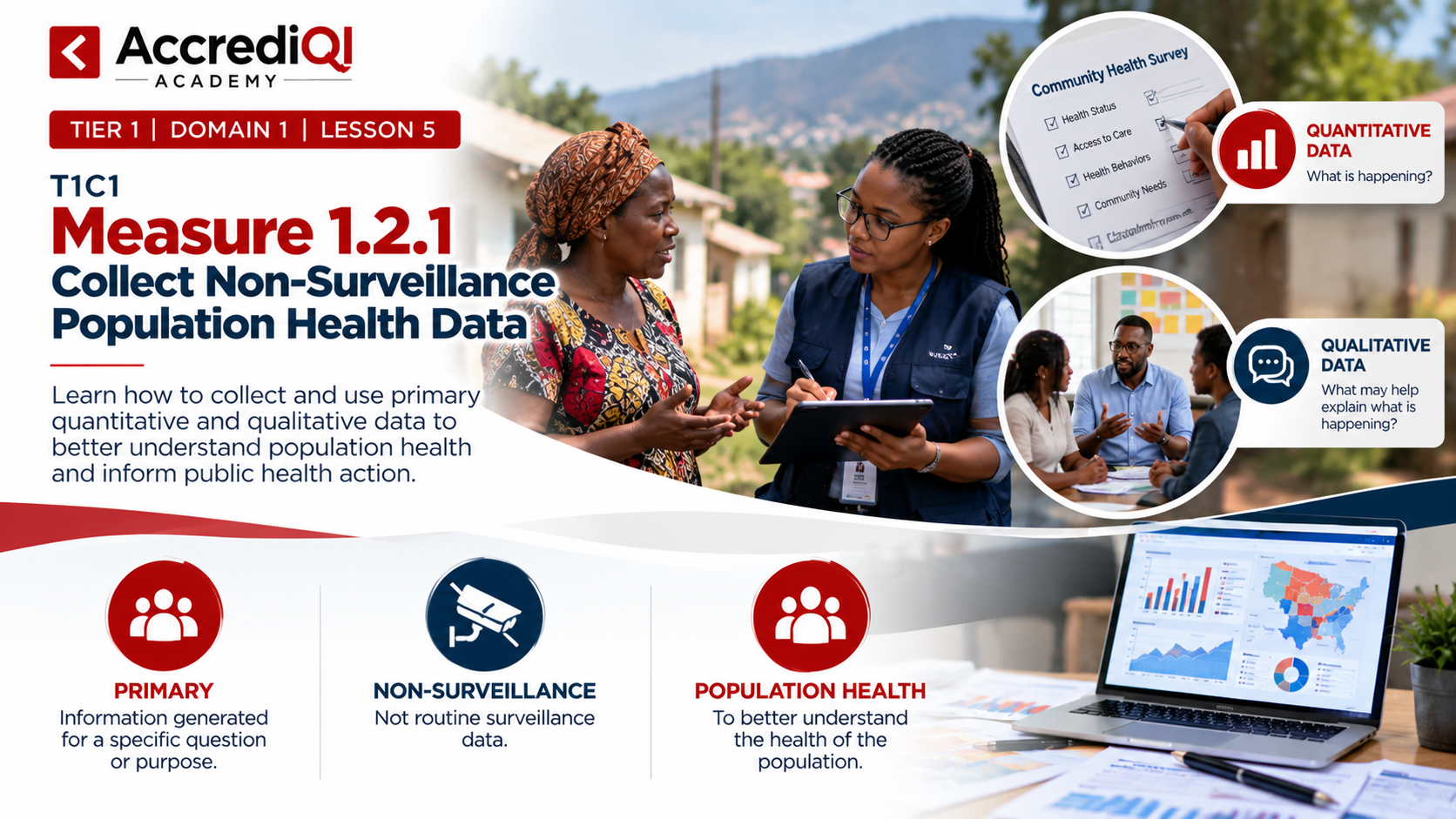
About Course
T1C1-L05 — Measure 1.2.1: Collect Non-Surveillance Population Health Data
This lesson provides practical guidance on PHAB Measure 1.2.1, focusing on collecting and using primary quantitative and qualitative non-surveillance population health data. Learners will distinguish qualifying data collection activities from surveillance and program evaluation, assess documentation against PHAB requirements, and identify opportunities to integrate accreditation-ready data collection into routine public health practice.
Target Audience: Accreditation coordinators, health department leaders, epidemiologists, population health analysts, quality improvement professionals, and public health program managers.
Duration: 20 minutes 42 seconds.
Course Content
T1C1-L05 — Measure 1.2.1: Collect Non-Surveillance Population Health Data
Video Instruction: 20 minutes 42 seconds
Lesson Purpose
Measure 1.2.1 examines the health department's ability to collect and use primary, non-surveillance population health data to improve its understanding of the health of the population it serves.
The Community Health Assessment provides a broad picture of population health, but it cannot answer every question that emerges in routine public health practice. Health departments frequently need additional information to investigate an emerging concern, better understand a population, explore the reasons behind a pattern, or inform a public health decision.
Measure 1.2.1 recognizes this routine assessment function.
The measure focuses on two complementary forms of evidence:
RD1 — Primary quantitative population health data
and
RD2 — Primary qualitative population health data
Together, they help the health department understand both:
What is happening?
and
What may help explain what is happening?
Learning Objectives
Upon completion of this lesson, you will be able to:
T1C1-L05-LO1 — Differentiate primary data from secondary data and surveillance data from non-surveillance population health data.
T1C1-L05-LO2 — Determine whether a routine health department activity constitutes primary, non-surveillance population health data collection under Measure 1.2.1.
T1C1-L05-LO3 — Evaluate quantitative population health evidence against the requirements of RD1, including what was collected, why it was collected, the population involved, the health department's role, and what the data revealed.
T1C1-L05-LO4 — Evaluate qualitative population health evidence against the requirements of RD2, including who was engaged, how information was collected, why the information was relevant, the health department's role, and what emerged from the inquiry.
T1C1-L05-LO5 — Differentiate population health assessment activities that may satisfy Measure 1.2.1 from program evaluation activities that do not serve the same purpose.
T1C1-L05-LO6 — Apply Measure 1.2.1 requirements to identify and strengthen routine health department practices that can generate accreditation-ready quantitative and qualitative population health evidence.
Watch the Lesson
As you watch, keep three concepts in mind:
PRIMARY
NON-SURVEILLANCE
POPULATION HEALTH
An activity must be understood through all three lenses.
Do not ask only:
“Did we collect data?”
Ask:
“Did the health department play a role in generating new information, outside routine surveillance, for the purpose of better understanding the health of a population?”
That distinction is the foundation of Measure 1.2.1.
The Purpose of Measure 1.2.1
The data required under Measure 1.2.1 complement the information available through the Community Health Assessment.
A CHA provides a broad assessment of community health. But new questions continually arise.
For example:
A CHA may show high adolescent alcohol use.
Emergency department data may reveal an unusual cluster of asthma attacks.
Community partners may raise concerns about transportation, food access, housing conditions, or behavioral health.
The health department may then need to collect additional information to better understand the issue.
Measure 1.2.1 captures that organizational capacity.
Think of the measure as helping answer two related questions:
What is happening?
Quantitative information helps identify magnitude, frequency, distribution, or patterns.
What is behind what we are seeing?
Qualitative information helps explore experiences, perspectives, circumstances, and possible explanations.
The two approaches are different, but complementary.
Concept 1 — What Does “Primary Data” Mean?
Primary data are information generated specifically for the question or purpose being investigated.
The health department does not necessarily have to personally perform every step of data collection.
It may:
collect the information directly;
oversee the data collection;
contract with another organization to collect it;
collaborate with another organization in collecting it.
The critical question is:
Can the health department demonstrate its role in producing or generating the information?
This distinguishes primary data from information that simply already existed elsewhere.
Example
If a health department downloads existing Census information, that is secondary data.
If the department conducts a resident survey to understand barriers to accessing healthcare, the survey responses are primary data.
If a university conducts the survey under an arrangement with the health department and the department can demonstrate its role in initiating, designing, overseeing, or collaborating on the work, the resulting information may still demonstrate the health department's role in primary data collection.
The key concept is not simply who held the clipboard.
The key question is whether the health department was meaningfully involved in generating the data for the population health purpose being addressed.
Concept 2 — What Does “Non-Surveillance” Mean?
Public health departments routinely collect surveillance data.
Examples may include:
reportable disease surveillance;
syndromic surveillance;
immunization registries;
other ongoing systems designed to continuously monitor defined conditions.
Measure 1.2.1 is looking for something different.
Non-surveillance data collection is generally initiated to answer a particular population health question rather than being generated through an ongoing surveillance system.
For example, suppose surveillance data reveal an unusual increase in asthma-related emergency department visits in one apartment complex.
The surveillance data may identify the signal.
The health department may then conduct:
resident interviews;
environmental observations;
photographs;
a targeted survey; or
another assessment activity
to better understand what may be contributing to the problem.
The surveillance system identified the concern.
The targeted inquiry generated additional non-surveillance population health information.
That distinction is central to Measure 1.2.1.
Concept 3 — What Makes It Population Health Data?
Not every piece of information collected by a health department is population health data.
Health departments collect information for many reasons:
managing employees;
processing permits;
monitoring contracts;
evaluating individual staff performance;
administering programs;
tracking expenditures.
Those activities may be important, but they do not automatically become population health assessment activities.
For Measure 1.2.1, the information should help the health department better understand:
the health status of a population
or
the factors that influence population health.
The focus therefore shifts from the internal operation of the health department to the health and conditions experienced by the population it serves.
The Three-Part Test
When considering a possible Measure 1.2.1 example, apply this screening test:
1. Is it primary?
Did the health department generate, commission, oversee, or collaborate in generating the information for the question being examined?
2. Is it non-surveillance?
Was the information collected outside an ongoing surveillance process to investigate or better understand a specific population health question?
3. Is it population health information?
Does the information help the health department understand the health of a population or factors influencing that health?
If the answer to all three questions is yes, the activity may be a strong candidate for Measure 1.2.1.
Two Complementary Required Documentation Areas
Measure 1.2.1 uses two forms of evidence.
RD1 — Primary Quantitative Population Health Data
Quantitative data help answer questions involving numbers.
They can describe:
magnitude;
prevalence;
frequency;
distribution;
differences among groups;
trends;
other measurable characteristics.
RD2 — Primary Qualitative Population Health Data
Qualitative data help us understand:
experiences;
perspectives;
observations;
circumstances;
explanations;
contextual factors.
A useful way to remember the distinction is:
Quantitative data help tell us what is happening.
Qualitative data can help us understand the experiences and conditions behind what is happening.
Neither form of information is inherently superior.
A mature public health assessment system knows when each is useful.
RD1 — Primary Quantitative Population Health Data
For RD1, do not think simply:
“We conducted a survey.”
The important question is whether the documentation tells the complete population health story.
A strong quantitative example should allow the Accreditation Coordinator to answer five questions.
1. What Was Collected?
Identify the actual quantitative information collected.
Examples might include:
survey responses;
blood-pressure measurements;
counts;
frequencies;
screening results;
structured assessment responses;
other numeric population health information.
2. Why Was It Collected?
What population health question prompted the activity?
The purpose should connect the data collection to understanding the health of the population or factors that influence health.
3. From Whom or What Population Was It Collected?
The evidence should make the population clear.
For example:
adolescents attending area schools;
residents of a defined neighborhood;
patients participating in community screening activities;
members of a particular population experiencing a health concern.
4. What Was the Health Department's Role?
Did the department:
design the activity;
collect the information;
oversee collection;
contract for it;
collaborate with another organization?
The role should be clear enough to establish the health department's participation in generating the data.
5. What Did the Data Tell Us?
This is particularly important.
A spreadsheet alone may establish that numbers exist.
A stronger population health product tells the reader what those numbers revealed.
The analysis should translate the data into findings that improve understanding of the population.
Example — Adolescent Binge Drinking Survey
Suppose a health department conducts a community survey after concerns emerge about alcohol use among adolescents.
A strong Measure 1.2.1 example does more than show a survey instrument.
It explains:
What was collected?
Information about alcohol use and related behaviors.
Why?
To better understand adolescent binge drinking in the jurisdiction.
From whom?
The relevant adolescent population.
What was the health department's role?
The department participated in designing, administering, overseeing, or analyzing the survey.
What did the information reveal?
The resulting report identifies findings, patterns, or population differences relevant to the public health concern.
That final step changes raw data into usable population health information.
Routine Activities Can Generate Population Health Evidence
Measure 1.2.1 does not necessarily require a health department to invent a special activity for accreditation.
Existing practice may already generate suitable evidence.
Consider community blood-pressure screening.
If measurements collected through routine clinics or outreach activities are aggregated and analyzed to better understand hypertension among a defined population, that routine activity may generate useful population health information.
This leads to an important Accreditation Coordinator mindset:
Do not begin by asking what new project the health department must create for PHAB.
First ask:
“Where in our routine work are we already generating information that helps us understand population health?”
Accreditation should recognize good public health practice—not create unnecessary parallel work.
From Data Collection to a Population Health Product
The strongest evidence does not end with raw data.
The health department should be able to move from:
DATA COLLECTION → ANALYSIS → FINDINGS
For example:
A survey instrument demonstrates how information was collected.
A dataset demonstrates that responses exist.
But a population health report demonstrates:
what was collected;
why it mattered;
who was included;
the health department's role; and
what the information revealed.
The goal is not simply evidence that data were collected.
The goal is evidence that the health department used primary data to better understand population health.
Use Caution — Program Evaluation Is Different
One important distinction in this lesson is between population health assessment and program evaluation.
They may use similar methods.
Both may involve:
surveys;
interviews;
focus groups;
quantitative indicators;
qualitative information.
But the purpose of the activity matters.
Program Evaluation
Program evaluation begins with an intervention, service, or program that already exists.
Typical questions include:
Was the intervention implemented as intended?
Did participants receive the service?
Did the program achieve its objectives?
What effect did the intervention have?
The unit of inquiry is primarily the program or intervention.
Measure 1.2.1 Population Health Inquiry
Measure 1.2.1 begins with a question about the population.
Typical questions include:
What are the population's needs?
What additional needs are emerging?
What are residents experiencing?
What conditions or circumstances may help explain the observed health issue?
The unit of inquiry is primarily the population and its health experience.
The same method can therefore serve different purposes.
A focus group conducted to evaluate whether an existing diabetes program satisfied participants is fundamentally different from a focus group conducted to understand barriers to diabetes prevention among residents.
The method does not determine whether the activity fits Measure 1.2.1.
The purpose does.
RD2 — Primary Qualitative Population Health Data
Quantitative data can tell us that a problem exists.
Sometimes we then need another form of information to understand the problem more deeply.
Qualitative methods allow the health department to explore:
experiences;
perceptions;
barriers;
environmental circumstances;
community explanations;
underlying conditions;
context that numbers alone may not reveal.
Examples can include:
Pathway 1 — Hear the Story
focus groups;
interviews;
listening sessions;
structured community discussions.
Pathway 2 — See the Context
structured observations;
photographs;
participatory approaches;
other methods that systematically capture environmental or lived context.
The important point is not that one method is preferable.
The method should match the population health question.
Evaluating RD2 — Five Questions
When reviewing qualitative evidence, the Accreditation Coordinator should be able to answer:
1. Who Was Engaged?
Whose experiences or environments were examined?
2. How Was the Information Collected?
Was it gathered through:
interviews;
focus groups;
observation;
photographs;
listening sessions;
another appropriate qualitative method?
3. Why Was the Information Relevant?
What population health question was the inquiry intended to help answer?
4. What Was the Health Department's Role?
How did the health department participate in initiating, collecting, overseeing, interpreting, or using the information?
5. What Emerged?
What themes, observations, experiences, or findings came from the qualitative inquiry?
Again, the documentation should not stop with:
“We held a focus group.”
The question is:
“What did we learn from it about population health?”
Example — Asthma Cluster at an Apartment Building
Consider a health department that identifies a cluster of asthma-related emergency department visits among residents of a large apartment building.
Existing quantitative or surveillance information identifies the concern.
The next question is:
What may be contributing to this pattern?
The health department conducts an environmental assessment of common areas and selected units.
The assessment documents conditions such as:
moisture;
visible mold;
poor ventilation;
water damage;
other environmental conditions that may affect respiratory health.
Photographs and structured observations capture the environmental context.
The findings are reviewed with the asthma workgroup and used to inform decisions about next steps.
This is important because the photographs are not simply decorative evidence.
They form part of a systematic qualitative inquiry into environmental conditions affecting population health.
The evidence therefore connects:
Triggering population health concern → Qualitative inquiry → Observations → Interpretation → Public health understanding
Qualitative Evidence Still Requires Rigor
Qualitative does not mean informal.
A photograph with no explanation is simply a photograph.
A collection of comments with no indication of who was engaged, why they were asked, or what themes emerged may not tell the necessary population health story.
Strong qualitative evidence provides enough context to understand:
Who?
How?
Why?
What was the health department's role?
What did we learn?
The goal is to make the reasoning behind the qualitative inquiry visible.
Think Like an Accreditation Coordinator
Your role is broader than collecting documents after the fact.
Measure 1.2.1 presents an opportunity to help the organization recognize where routine practice already generates population health information—and where those practices can be strengthened.
Ask:
Where do we routinely collect information directly from or about populations?
Which activities are primary rather than simply using existing data?
Which activities occur outside surveillance systems?
Which are genuinely intended to improve our understanding of population health?
Do we use both quantitative and qualitative approaches when appropriate?
Do our reports explain what we learned rather than simply show that data were collected?
Those questions move the organization toward continuous population health assessment rather than episodic accreditation preparation.
Hardwire Measure 1.2.1 Into Routine Practice
One of the strongest approaches is to institutionalize Measure 1.2.1 expectations within normal health department procedures.
A routine process can help the department ensure that when primary population health data are collected, staff consistently document:
What was collected
Why it was collected
Who or what population was involved
The health department's role
What the information revealed
The same principle applies to qualitative inquiry.
The goal is:
Good practice generates accreditation evidence through routine practice—not through reconstruction when accreditation is due.
Key Takeaway
Measure 1.2.1 is not simply about proving that the health department occasionally conducts surveys or focus groups.
It examines whether the department has the capacity to generate additional primary information when it needs to better understand population health.
Remember the three-part test:
PRIMARY → NON-SURVEILLANCE → POPULATION HEALTH
And remember the complementary role of the two Required Documentation areas:
RD1 — Quantitative: What do the numbers tell us?
RD2 — Qualitative: What do experiences, observations, and context help us understand?
The Accreditation Coordinator should be able to recognize these activities in routine practice, distinguish qualifying from non-qualifying activities, evaluate the quality of the resulting evidence, and help the organization build the requirements into its normal population health assessment processes.
-
T1C1-L05 — Measure 1.2.1: Collect Non-Surveillance Population Health Data
20:42 -
T1C1-L05 — Lesson Knowledge Check