T1C1-L06 — Measure 1.2.2: Participate in Data Sharing With Other Entities

Uncategorized

About Course

T1C1-L06 — Measure 1.2.2: Participate in Data Sharing With Other Entities
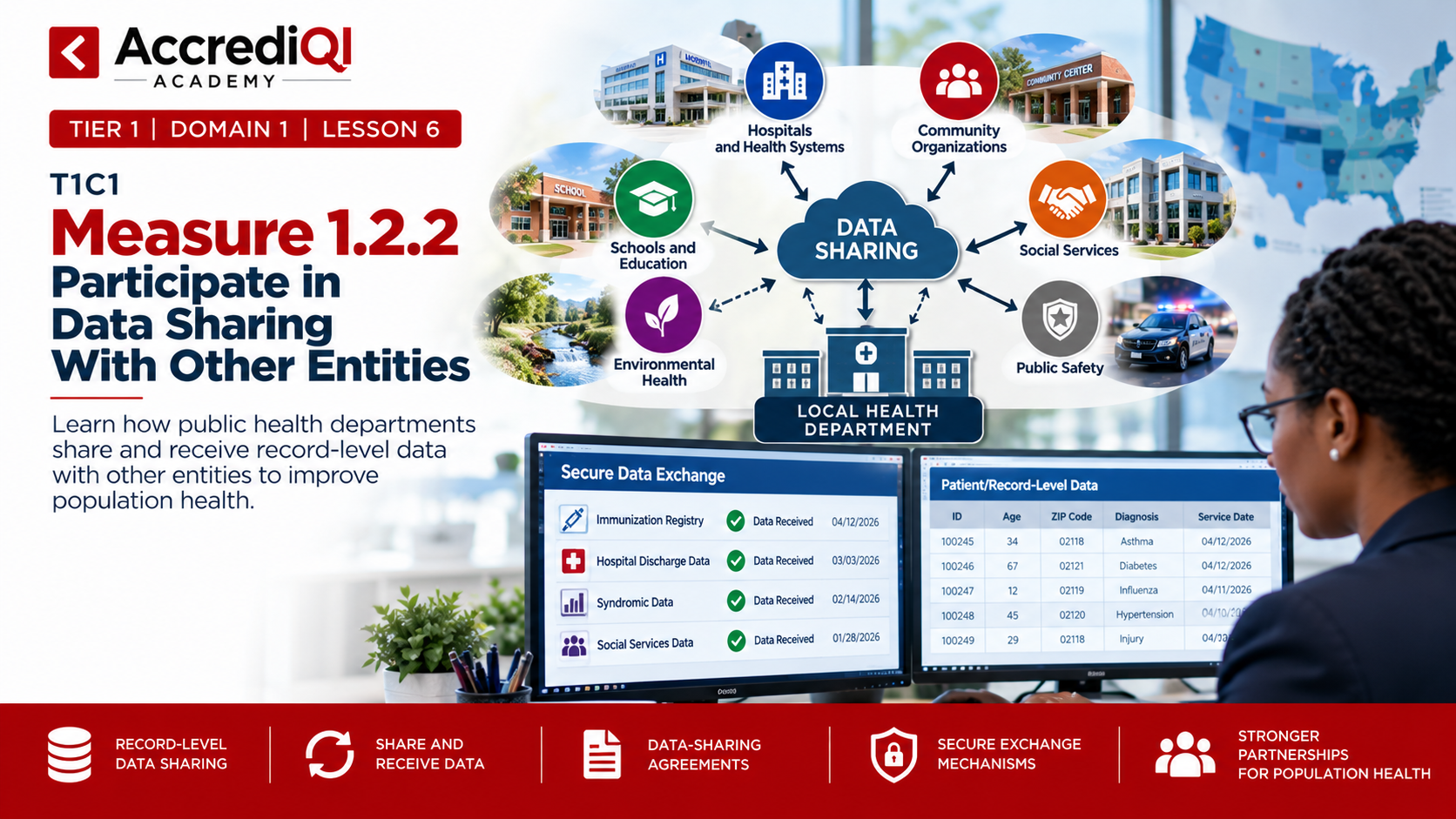
This lesson provides practical guidance on PHAB Measure 1.2.2, focusing on how Tribal and local health departments share and receive record-level data with other entities. Learners will distinguish data sharing from disseminating aggregate findings, evaluate documentation demonstrating actual data exchanges, and explore data-sharing agreements, registries, secure transfers, and partnerships. The lesson equips participants to identify qualifying evidence, demonstrate conformity with PHAB requirements, and strengthen sustainable data-sharing practices.

Target Audience: Accreditation coordinators, Tribal and local health department leaders, epidemiologists, data managers, health information specialists, quality improvement professionals, and public health program managers.

Show More

Course Content

T1C1-L06 — Measure 1.2.2: Participate in Data Sharing With Other Entities
Lesson Purpose Measure 1.2.2 examines whether Tribal and local health departments participate in data sharing with other entities. For an Accreditation Coordinator, the competency goes beyond locating a data-sharing agreement or finding evidence that information was sent to a partner. You must be able to determine whether an activity actually constitutes data sharing for purposes of the measure, distinguish record-level data from aggregate findings, evaluate whether documentation demonstrates an actual exchange, and help the organization establish sustainable relationships and mechanisms for sharing and receiving data. Data sharing should be understood as a two-way organizational capability: the health department may provide data to other entities and may receive or gain access to data held by partners. Learning Objectives By the end of this lesson, you will be able to: T1C1-L06-LO1 — Differentiate record-level data sharing under Measure 1.2.2 from the dissemination of aggregate findings addressed elsewhere in Domain 1. T1C1-L06-LO2 — Determine whether a proposed data-sharing activity meets the measure's requirements by evaluating the nature of the data, the exchange with another entity, the documentation timeframe, and the evidence of participation. T1C1-L06-LO3 — Evaluate documentation from registries, portals, secure transfers, agreements, and other mechanisms to determine whether it demonstrates that record-level data were actually shared or received. T1C1-L06-LO4 — Identify opportunities to strengthen the health department's relationships and mechanisms for obtaining and providing data needed to assess and monitor population health. Watch the Lesson As you watch, keep one question in mind: Can we demonstrate that record-level data actually moved between the health department and another entity? Do not focus first on the technology used to exchange the data. A registry, health information exchange, reporting platform, portal, or secure email can all potentially support data sharing. The mechanism can vary. What matters is whether the evidence demonstrates an actual exchange of qualifying data. What Does Data Sharing Mean? Data sharing involves providing data to another entity or receiving data from another entity. The health department might: PROVIDE DATA Health Department → Partner or RECEIVE DATA Partner → Health Department Partners may come from healthcare, education, housing, transportation, environmental health, emergency services, or other sectors. This is why an Accreditation Coordinator should not ask only: “Can our department send someone a dataset?” A stronger organizational question is: “Do we have the relationships and mechanisms needed to provide and receive the data necessary to understand our population's health?” Those mechanisms may include data-use agreements, data-sharing agreements, portals, exchanges, secure transfer processes, and established cross-sector partnerships. Data Sharing Is Not the Same as Sharing Findings This is one of the most important distinctions in the lesson. Suppose a health department analyzes diabetes data and tells a community partner: “Diabetes prevalence is 12%.” The partner has received a finding. It knows the conclusion produced by the analysis. Now suppose the health department provides a dataset containing individual records with variables such as age, ZIP code, diagnosis, and healthcare utilization. The recipient now possesses records that can be subjected to additional analysis. That is the distinction: Sharing findings: The recipient receives what the analysis concluded. Sharing data: The recipient receives records that can be analyzed further. The lesson therefore distinguishes: Standard 1.3: Analyze → Share Findings → Use from Measure 1.2.2: Share ↔ Receive Data. What Is Record-Level Data? For this lesson, think of record-level data as information organized around individual units that remain available for additional analysis. One row might represent: a person, a facility, a clinic, a jurisdiction, a specimen site, or another individual unit of analysis. For example, a deidentified patient-level dataset might contain separate records showing age, ZIP code, diagnosis, and utilization. The practical test is: Can the recipient use the records to conduct additional analysis? If yes, you may be looking at record-level data. By contrast: “Diabetes prevalence = 12%” is an aggregate finding. It summarizes what the data show but does not provide the underlying records for further analysis. Required Documentation for Tribal and Local Health Departments The lesson identifies one Required Documentation requirement. The health department must provide: Two examples of participation in data sharing with other entities. Each example must: fall within the past five years, and involve record-level data. This means that simply finding two documents containing data is not enough. For each potential example, the Accreditation Coordinator should determine: 1. Is another entity involved? There must be an exchange involving the health department and another entity. 2. Was record-level data involved? Determine whether the information exchanged consists of records capable of additional analysis rather than only aggregate statistics, reports, dashboards, or conclusions. 3. Can we demonstrate that an exchange actually occurred? Evidence should establish that the department participated in sharing or receiving the data. 4. Is the example within the required timeframe? Each example must be dated within the past five years. Follow the Data, Not the Technology A common accreditation mistake is to focus too heavily on the system used. For example: “We have access to an immunization registry.” “We participate in an HIE.” “We have a data-sharing portal.” “We have a data-sharing agreement.” Those facts may be important, but the stronger accreditation question is: Can we demonstrate that record-level data were actually shared or received? The lesson identifies several possible routes, including registries, reporting platforms, connected EHR/HIE systems, and secure file transfers. The route itself is flexible; evidence of the actual exchange is what matters. Evaluating Potential Documentation Documentation may take several forms. For example: Registry Screenshot A screenshot may demonstrate that the health department receives record-level information through a registry. Data-Sharing Portal A portal may demonstrate that the department makes record-level information available to authorized partners. Secure Transmission Evidence A secure email or transmission record may demonstrate that record-level data were transmitted to another entity. The deck uses these three mechanisms as practical examples of evidence that may demonstrate receiving or sharing data. The Accreditation Coordinator's task is not merely to recognize the mechanism. Ask: What does this document actually prove? A screenshot of a system may establish access to the system but may not necessarily establish the particular exchange you are trying to document. Similarly, a data-sharing agreement can demonstrate that relationships, responsibilities, and mechanisms have been established, but the accreditation evidence should still enable the reviewer to determine that qualifying data sharing occurred. The Accreditation Coordinator's Role Measure 1.2.2 should not be approached only as a search for two historical examples. The stronger competency is to help the organization develop a sustainable data-sharing infrastructure. This includes identifying: Data — What information does the health department need to provide or obtain? Partners — Which organizations hold information relevant to population health? Permitted Uses — What may each party do with the data? Privacy and Security — How will sensitive information be protected? Method of Exchange — How will information move between organizations? Responsibilities — Who is responsible for providing, receiving, maintaining, and using the information? The lesson's practice exercise therefore asks learners to build a Data Sharing Agreement addressing these elements. Such an agreement can help establish relationships, responsibilities, and mechanisms that support future data exchange and accreditation documentation. Accreditation Coordinator's Quick Test When evaluating a potential Measure 1.2.2 example, use this sequence: Another entity? → Record-level data? → Actual exchange? → Within five years? → Evidence sufficient? If one of these questions cannot be answered from the documentation, investigate further before selecting the example for submission. Key Takeaway Measure 1.2.2 is not fundamentally about whether a health department publishes reports or possesses sophisticated data technology. It asks whether the health department participates in sharing record-level data with other entities. For the Accreditation Coordinator, the competency is twofold: Accreditation competency: recognize qualifying exchanges and assemble evidence demonstrating them. Organizational competency: help establish the relationships, agreements, systems, and practices that allow the department to obtain and provide the data it needs.

  • T1C1-L06 — Measure 1.2.2: Participate in Data Sharing With Other Entities
    11:21
  • T1C1-L06 — Lesson Knowledge Chec